
The blurring lines of our digital reality
We have all been there, scrolling through a social media feed and stopping dead in our tracks at a photo that looks just a bit too perfect. Maybe it is a politician in a situation that seems unlikely, or a landscape that looks like it belongs in a dream. The first question that pops into your head is always the same: is this photo real or AI? It is a question that would have seemed absurd a few years ago, but today, it is a necessary part of digital literacy. As generative artificial intelligence continues to evolve, the gap between a captured moment and a synthesised one is narrowing to a point where our natural instincts often fail us.
The speed at which these tools have improved is nothing short of staggering. We have moved from distorted, multi-fingered nightmares to photorealistic portraits in what feels like a matter of months. This rapid advancement means we can no longer rely on a quick glance to verify the truth. Instead, we have to become digital detectives, looking for the subtle glitches and logical inconsistencies that the algorithms still struggle to iron out. Understanding the nuances of these images is not just about avoiding being fooled; it is about maintaining a grip on what is actually happening in the world around us.
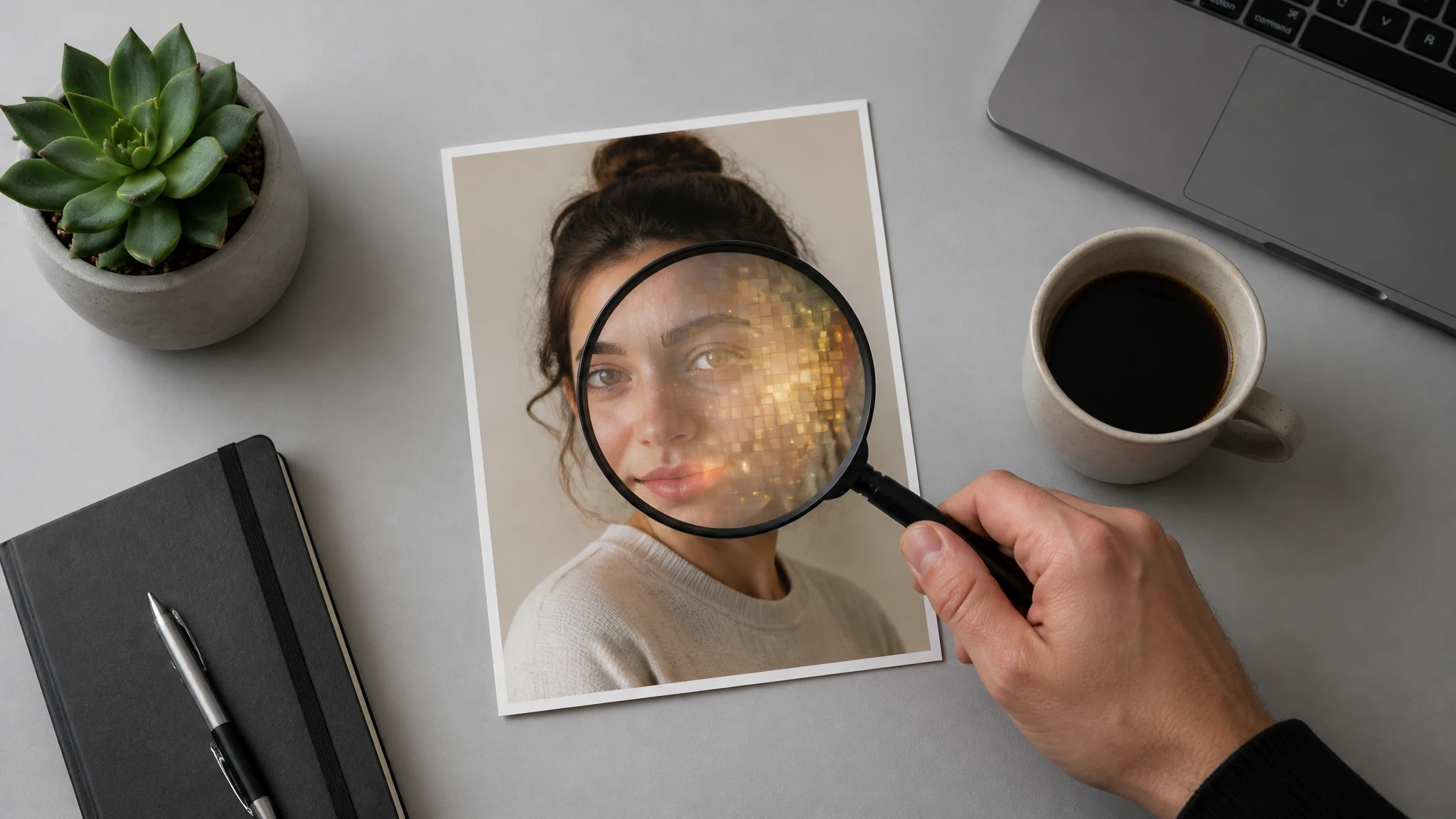
Why our eyes often fail the first test
Human brains are hardwired to recognise patterns, but we are also easily swayed by emotion and aesthetic appeal. When an AI generates an image, it is essentially predicting what a photo should look like based on billions of examples. It understands the “vibe” of a sunset or the texture of a knitted jumper, but it does not understand the underlying physics or the biological rules of the human body. However, because the final result is often high-resolution and vibrant, our initial reaction is to accept it as a photograph.
When you find yourself asking is this photo real or AI, the first thing you should do is zoom in on the edges of the subject. AI often struggles with the boundary where one object ends and another begins. You might see a slight blurring or a strange merging of textures that would never happen in a real optical lens. These “liminal” spaces are often the first place the technology starts to break down, revealing the mathematical approximations happening behind the scenes.
The tell-tale signs of an AI generation
While the technology is getting better, there are still several recurring issues that act as red flags for the discerning viewer. These are not always obvious at first, but once you know what to look for, they become much easier to spot. AI models are essentially very sophisticated “guessers,” and they often guess wrong when it comes to complex structures.
- The struggle with extremities: Check the hands, feet, and ears. While the “six-finger” trope is becoming less common, AI still struggles with the way fingers overlap or the specific way an ear lobe attaches to the head.
- Inconsistent jewellery and accessories: Look at earrings or glasses. Often, an AI will generate one earring that looks different from its pair, or the frames of a pair of glasses will morph into the person’s temple.
- Textural anomalies: AI often applies a “plastic” or overly smooth texture to skin, making people look like they have been airbrushed to an impossible degree. Conversely, hair can often look like a solid mass or a series of disconnected fibres.
- The background blur: While professional cameras use “bokeh” to blur backgrounds, AI often blurs things inconsistently, leaving sharp patches in the middle of a blurry field or vice versa.
The logic of the environment
Beyond the physical appearance of the people in the frame, the environment often tells a different story. A real photograph captures a slice of a physical world that follows the laws of physics. AI, on the other hand, is just placing pixels where it thinks they belong. This leads to “hallucinations” in the background that are often hilarious or deeply unsettling once you notice them.
Look at the architecture in the background. Are the windows symmetrical? Do the stairs actually lead anywhere, or do they dissolve into a wall? In many AI-generated images of crowds, the people in the distance often turn into distorted, faceless shapes that look like something out of a horror film. These background details are usually where the AI’s processing power is at its lowest, as it focuses most of its energy on the central subject.
Text and language in the frame
One of the most reliable ways to answer the question of whether a photo is real or AI is to look for any written text within the image. Until very recently, AI was notoriously bad at rendering legible text. Even the most advanced models today can still struggle with the specific typography of a street sign or the labels on a bottle. If the text looks like a strange, alien language or a series of nonsensical symbols that resemble English but don’t quite make sense, you are almost certainly looking at an AI generation. Real photos have crisp, logical text that follows a specific font and perspective.
Lighting, shadows, and the laws of physics
Lighting is perhaps the hardest thing for an AI to get perfectly right. In a real photo, the light source is consistent. If the sun is behind a person, their shadow should fall in front of them, and the highlights on their hair should match that direction. AI often creates “impossible” lighting, where shadows are cast in multiple directions or a subject is illuminated by a light source that simply does not exist in the environment.
Reflections are another major giveaway. If a person is standing next to a window or a puddle, check the reflection. AI often fails to create a mirrored version of the scene, instead generating a generic “glassy” effect that doesn’t actually reflect the objects around it. Similarly, look at the eyes. The “catchlight” (the tiny white reflection of light in a person’s pupil) should be identical in both eyes in a real photo. If the shapes are different or missing entirely, the image is likely a product of an algorithm.
Using tools to verify the truth
Sometimes, our eyes are not enough. When an image is particularly well-crafted, we need to turn to technical solutions to find the answer. The first and easiest step is a reverse image search using tools like Google Lens or TinEye. If a photo is real, it will often have a history; it might have been published by a news agency or shared by a photographer months or years ago. If the image only recently appeared and has no clear source, that is a significant warning sign.
There are also specialised AI detectors available online. While these are not 100% accurate, they can provide a probability score. These tools look for mathematical patterns in the pixels that are characteristic of specific AI models. However, it is important to remember that these tools are in a constant arms race with the AI generators themselves, so they should be used as one part of a wider investigation rather than a definitive proof.
The importance of metadata and provenance
In the professional world, the fight against AI misinformation is moving towards “provenance.” This involves embedding digital signatures into photos at the moment they are taken with a camera. These signatures can tell you exactly which camera was used, the GPS coordinates of the shot, and whether the file has been edited since it was created. While this technology is still being adopted, it represents the future of how we will distinguish reality from synthesis.
Without these signatures, we are left to rely on the context of where the image was found. Is it from a reputable news source with a history of fact-checking? Or is it from an anonymous account on X (formerly Twitter) with a history of posting sensationalist content? Often, the “why” behind an image is just as important as the “how.” If an image seems designed to provoke a strong emotional reaction or to support a specific political narrative, it deserves an extra level of scrutiny. Identifying an AI image is often less about the pixels and more about the logic of the situation being presented.
Sadie focuses on business growth strategies, market trends, and innovative solutions that drive operational efficiency and long-term success.